Metal Slug Tank – Hand-Painted Fan Art
Metal Slug turns 30 this year and this is my tribute to the license that shaped my childhood and made me throw countless coins into arcade machines without ever managing to finish the game.
I usually model from memory without references, but for something as complex as this, I had to rely on references from the original in-game tanks and then personalize them so it wouldn’t resemble any existing version too closely. Especially the engine section, with the ventilation grille and the two machine guns mounted directly onto it.
A great 3D artist once taught me that, just like in real life, nothing is perfectly straight or perfectly square. Even subtle variations matter because, even if we don’t consciously notice them, we subconsciously feel them. That’s why perfectly clean models rarely feel believable.
So I added many asymmetrical details: different roof equipment, a large antenna on only one side, slightly misaligned guns and antennas, even screws oriented differently from left to right. Small details like these bring life to a model, but they also completely break symmetrical texturing workflows and create much more work.
For the UVs, I usually only overlap truly identical parts, like tank treads, while keeping most of the model unique. This allows me to first texture symmetrically, then later hand-paint unique variations on each side. The downside is lower texel density, so it’s always a tradeoff.
I also manually place all my seams because no algorithm can predict how a model will actually be used. Normally I use automatic UV packers, but for hand-painted workflows in 3DCoat, organization matters more than perfect optimization. You constantly paint both on the model and directly on the texture, so finding your way quickly inside the UV layout becomes essential.
Interestingly, leaving some empty UV space is often useful too. When painting, you frequently realize too late that a small part was badly unwrapped, and having extra room makes fixing it much easier.
A small technical note: UV1 is usually used for textures, UV2 for baked lighting (lightmaps), and additional UV channels for advanced shader effects. Engines can auto-generate UV2s, but the result is rarely optimal. For lightmaps, minimizing seams matters far more than avoiding distortion, because texel density is already extremely low.
For performance reasons, I usually prefer building one large mesh rather than many smaller ones. But here I eventually had to split the model into many sub-parts because painting certain areas became impossible otherwise. Thankfully, once everything is painted, it can still be merged back together since all parts share the same texture atlas.
This project was also an opportunity to practice animation. Since the model has no deformation, there’s no need for bones or a skeleton rig. I often see artists using full skeletal rigs for very simple mechanical animations, but in-engine this becomes unnecessarily expensive compared to simple object animation.
As for texturing: I deliberately chose a hand-painted workflow in 3DCoat instead of a procedural workflow in Substance Painter because I wanted to improve in that direction. Hand-painted textures have a unique feeling to me, probably because I grew up with games built that way before procedural tools became the standard.
Hand-painted art also means painting the lighting itself. For games with mostly stable lighting, like League of Legends, it works extremely well. But for games with interiors, exteriors, and full day/night cycles, relying entirely on painted lighting becomes much harder.
My conclusion is that 3DCoat is still an incredible tool for this kind of work, and there’s a reason why Riot Games still uses it. The interface may look outdated, but once you push past that barrier, the painting experience feels much closer to traditional illustration than anything else I’ve used.
And finally: hand-painted art takes a huge amount of time. Like any artistic work, you can refine it forever because it’s never truly finished. In a world increasingly driven by AI, automation, speed, and cost reduction, creating assets entirely this way definitely feels like swimming against the current. Modern procedural tools are essential for large productions, otherwise games would take decades to finish. But even with all those tools, game development remains a constantly evolving collaborative artwork rather than a perfectly fixed plan from day one.
Fan-made tank inspired by the iconic Metal Slug series, created in Blender and fully hand-painted in 3DCoat Textura.

MetalSlug tank sv-001

Front view for the Metal Slug tank.

Side view for the Metal Slug tank.

Back view for the Metal Slug tank.
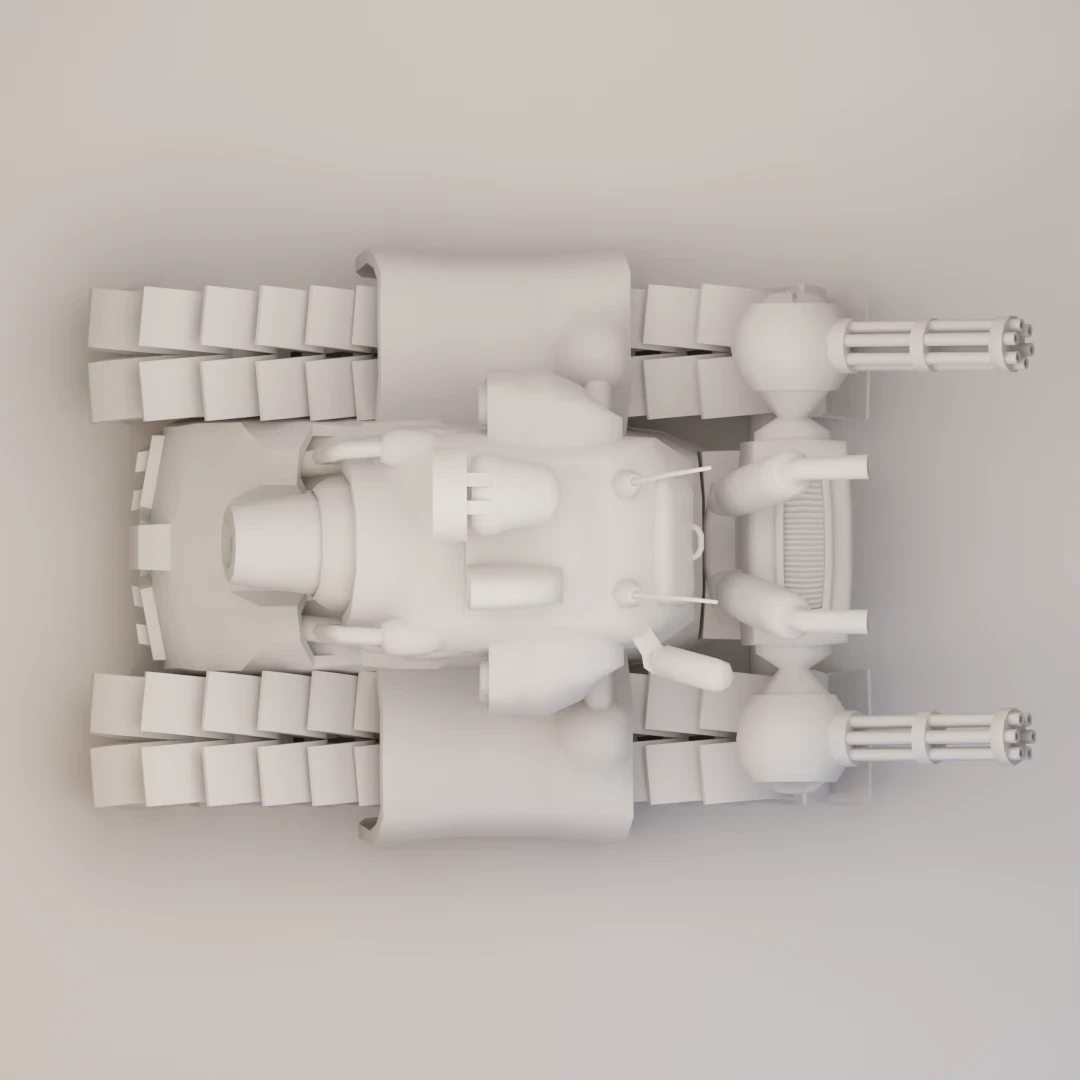
Top view for the Metal Slug tank.